

A typing speed test is most useful when you control text difficulty. If you test only on easy passages, your WPM can look strong while real writing still feels slow. A better method uses three passage tiers, compares median results, and tracks accuracy at each tier. This gives a reliable baseline for practical performance and helps you choose the right training focus.

If you are starting from scratch, first set up a stable benchmark process with this keyboard speed test benchmark guide. If your current training plan needs structure, use this type speed test practice plan. If you are balancing speed and error control, this words per minute test framework gives useful ranges.
# Why text difficulty changes typing speed test results
Most typing speed test tools report one number per run. That number is valid for that exact passage, but passage complexity shifts both speed and error rate.
Three factors create most variation:
- Word familiarity: common short words increase rhythm consistency.
- Character transitions: harder bigrams and punctuation break tempo.
- Cognitive load: denser syntax slows reading and preview planning.
This is consistent with findings in language processing and motor control research. Typing output depends on both movement execution and text processing load, so changing text complexity changes net throughput. See evidence from motor skill learning reviews at the National Library of Medicine (opens new window) and sentence processing research summaries from APA PsycNet (opens new window).
Practical takeaway: a single typing speed test score is incomplete. You need a profile across multiple difficulty levels.
# Define the three tier typing speed test model
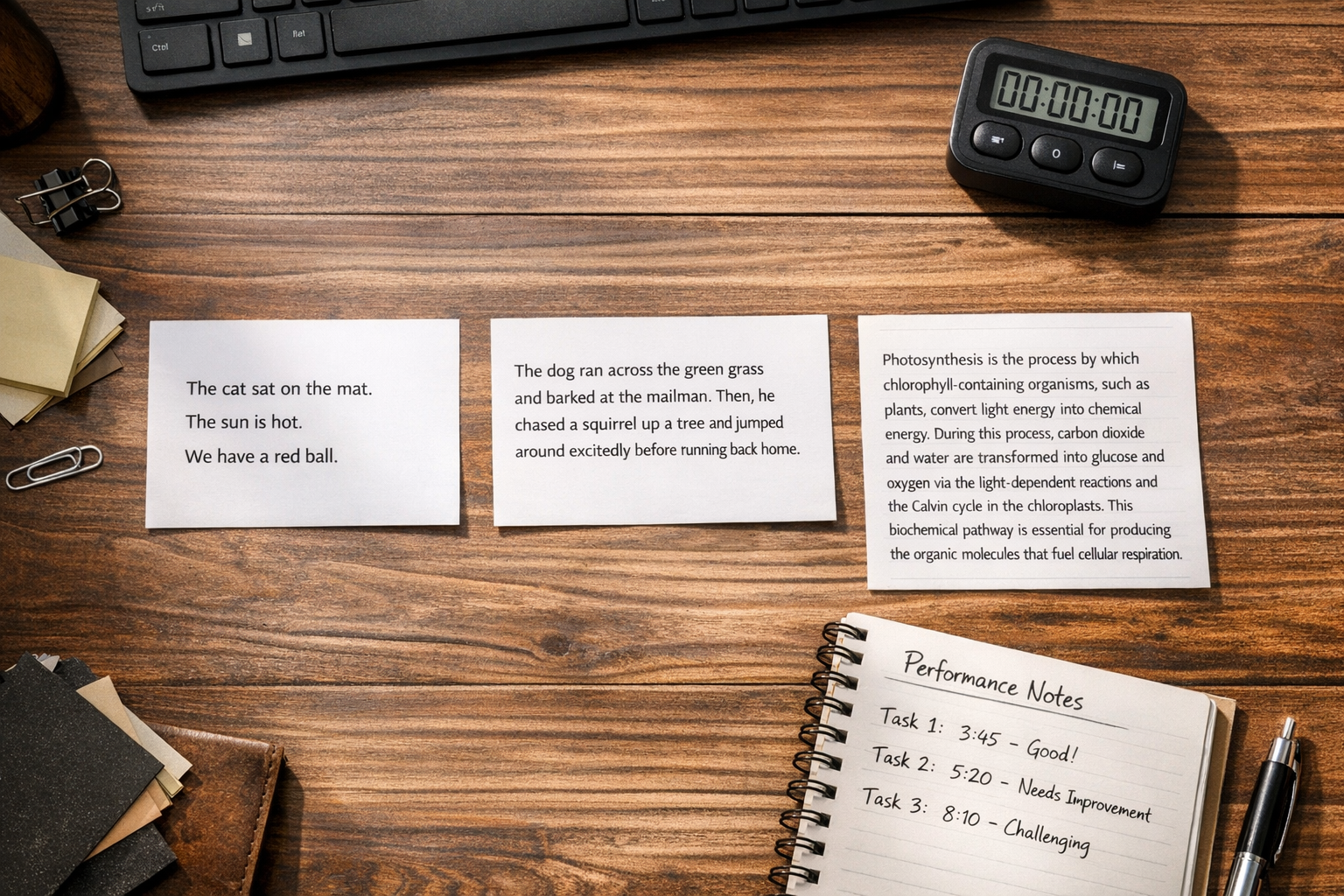
Use three passage tiers in every measured session:
- Easy tier: short words, simple sentence structure, low punctuation.
- Mixed tier: general prose with moderate punctuation and varied word length.
- Hard tier: dense technical or abstract prose with frequent punctuation.
Keep each run at 60 seconds for comparability. Use three runs per tier, then compute the median WPM and median accuracy for each tier.
# Decision table for interpreting tier gaps
| Pattern | Likely cause | Next training action |
|---|---|---|
| Easy high, mixed close, hard much lower | reading load bottleneck | add preview pacing drills and punctuation intervals |
| Easy and mixed high, hard accuracy collapse | overpacing on complex text | reduce pace target by 2 to 3 WPM on hard tier for one week |
| All tiers flat with stable accuracy | current plan saturated | rotate drills to weak bigrams and retest after 5 sessions |
| Easy improves but mixed and hard stall | recognition effect on simple text | reduce easy tier volume, increase mixed tier volume |
| Hard improves with stable errors | transfer quality improving | keep progression pace and repeat current drill mix |
This table keeps your adjustments objective. You change the plan based on tier behavior, not one top score.
# Build a clean test set without hidden bias
A typing speed test is only as trustworthy as its input passages. Build a small test set with fixed rules:
- 9 total passages, 3 per tier.
- 130 to 170 words per passage.
- Similar topic tone across tiers so only complexity changes.
- No repeated passage on the same day.
You can estimate complexity with readability metrics, then validate manually. Readability tools are imperfect for typing, but they help avoid extreme mismatch. Use references like Hemingway readability (opens new window) style methods and documentation on text complexity from CommonLit (opens new window) or equivalent education resources.
A practical cut:
- Easy tier near grade 4 to 6 prose.
- Mixed tier near grade 7 to 9 prose.
- Hard tier near grade 10+ prose with more punctuation density.
Do not optimize your test set to inflate results. Your goal is prediction of real output.
# Run protocol: 27 minutes, repeatable, low noise
Use this compact session design:
- Warmup: 3 minutes with unscored free typing.
- Easy tier: 3 runs x 60 seconds, 30 second rest.
- Mixed tier: 3 runs x 60 seconds, 30 second rest.
- Hard tier: 3 runs x 60 seconds, 45 second rest.
- Cooldown note: 3 minutes for logging and next action.
Total time is about 27 minutes including transitions.
Control environment every session:
- Same keyboard and firmware profile.
- Same browser and zoom.
- Same seating posture and desk height.
- Same time window when possible.
If you are experimenting with hardware settings, isolate those tests in separate sessions. Mixing hardware changes into routine sessions breaks comparability. For latency and keyboard measurement methodology, check Rtings keyboard latency methods (opens new window).
# How to score your typing speed test profile
Track these fields per run:
- Tier
- WPM
- Accuracy
- Backspace count if available
- One short error note
Then compute per tier:
- Median WPM
- Median accuracy
- Interquartile range for WPM if your tool exports it
Finally compute one practical index:
Usable WPM Index = (Mixed Median WPM x 0.6) + (Hard Median WPM x 0.4)
Why skip easy tier in the index? Easy tier is useful for rhythm diagnostics, but mixed and hard tiers reflect work output better for most users.
# Example interpretation from one week of tests
Assume this weekly median profile:
- Easy: 92 WPM at 97.8% accuracy
- Mixed: 79 WPM at 96.9% accuracy
- Hard: 67 WPM at 95.8% accuracy
Usable WPM Index = (79 x 0.6) + (67 x 0.4) = 74.2
What this tells you:
- Raw speed capacity exists.
- Complexity handling is the current limiter.
- Training should focus on mixed and hard passage transfer.
Next week target could be:
- Mixed +2 WPM with stable accuracy.
- Hard +2 WPM with no more than 0.3% accuracy loss.
This target is specific and measurable. It also avoids the common pattern where people chase easy tier highs that never transfer.
# Training adjustments that map to each tier
Use tier specific practice blocks:
# Easy tier work
Purpose is tempo stability. Keep this short.
- 4 minutes rhythm drills.
- 2 minutes correction discipline.
If easy tier keeps rising while other tiers do not, cap easy work at one block per session.
# Mixed tier work
Purpose is general transfer. This should be your largest block.
- 8 to 12 minutes mixed prose typing.
- Forced no sprint starts in first 15 seconds.
- Pace target at current mixed median plus 1 WPM.
Mixed tier responds well to deliberate pacing. You should feel slightly constrained at first, then smoother in later runs.
# Hard tier work
Purpose is complexity tolerance under control.
- 6 minutes punctuation interval drills.
- 4 minutes dense paragraph runs with strict accuracy floor.
Accuracy floor suggestion:
- Intermediate typists: 96%.
- Advanced typists: 97%.
If hard tier accuracy drops below floor for two sessions, reduce target pace and keep complexity constant for 48 hours.
# Weekly checklist for a reliable typing speed test routine
Use this once per week:
- [ ] Confirm passage pool still matches easy, mixed, and hard criteria.
- [ ] Replace one passage per tier to reduce memorization effects.
- [ ] Recalculate tier medians and Usable WPM Index.
- [ ] Compare with real task output on a 300 word writing sample.
- [ ] Decide one change only for next week.
One change per week keeps signal clear. Multiple simultaneous changes produce noise.
# Common mistakes that inflate typing speed test scores
# Passage memorization
If you repeat the same passage too often, results rise without true transfer. Rotate passages and maintain a log.
# Tier skipping
Some users skip hard tier on low energy days. That removes the most informative signal. Keep tier coverage complete even when session quality is average.
# Top score obsession
A single best run has low decision value. Use medians and trend lines.
# Hidden assist tools
Autocorrect and text expansion can change measured output. Keep tool state consistent across sessions.
# How this method maps to real work tasks
A typing speed test should support outcomes outside the test page. Validate with one weekly transfer task:
- 250 to 400 word original paragraph from notes.
- Normal writing environment.
- Track net WPM and correction burden.
If Usable WPM Index rises but transfer WPM stays flat, your drills are too test specific. Increase mixed prose practice and reduce easy tier volume.
If both rise together, your training is transferring correctly.
# FAQ
# How many times per week should I run this typing speed test model
Four to five sessions per week is enough for most users. More frequency can help, but only if fatigue remains controlled and logging quality stays high.
# Can I use this model when switching keyboard layout
Yes, but expect temporary drops in mixed and hard tiers. Keep targets conservative and compare trends over two weeks, not two days.
# What if my hard tier never improves
Inspect error notes. If errors cluster around punctuation and number rows, increase targeted interval drills. If errors spread randomly, reduce pace and shorten session length for one week.
# Is this useful for job typing tests
Yes. Many job screens resemble mixed tier text with time pressure. Improving mixed tier median with stable accuracy usually improves screening performance more than chasing easy passage highs.
A typing speed test becomes decision grade when you score across text difficulty tiers, track medians, and train to close tier gaps. Build the three tier profile once, run it for two weeks, and your next training cycle will have a clear target that matches real output.